

Key Takeaways
AI models are fundamentally reshaping data center energy consumption, with electricity demand projected to more than double by 2030.
- GPU-intensive AI workloads consume significantly more power than traditional computing tasks, with modern AI facilities requiring power densities that far exceed conventional data centers
- Inference operations, not training, account for the majority of ongoing AI energy consumption as billions of daily queries accumulate into massive aggregate demand
- The energy usage of AI models creates unprecedented infrastructure challenges, with grid interconnection delays extending years in major markets
- Organizations seeking competitive positioning must partner with energy infrastructure developers capable of delivering powered land solutions faster than traditional utility approaches
The artificial intelligence revolution is creating an energy transformation unlike anything the digital economy has experienced. While headlines focus on AI capabilities, a more fundamental story is unfolding in data centers worldwide: these facilities are consuming electricity at rates that are straining existing infrastructure and forcing a complete rethink of how power is delivered to computational workloads.
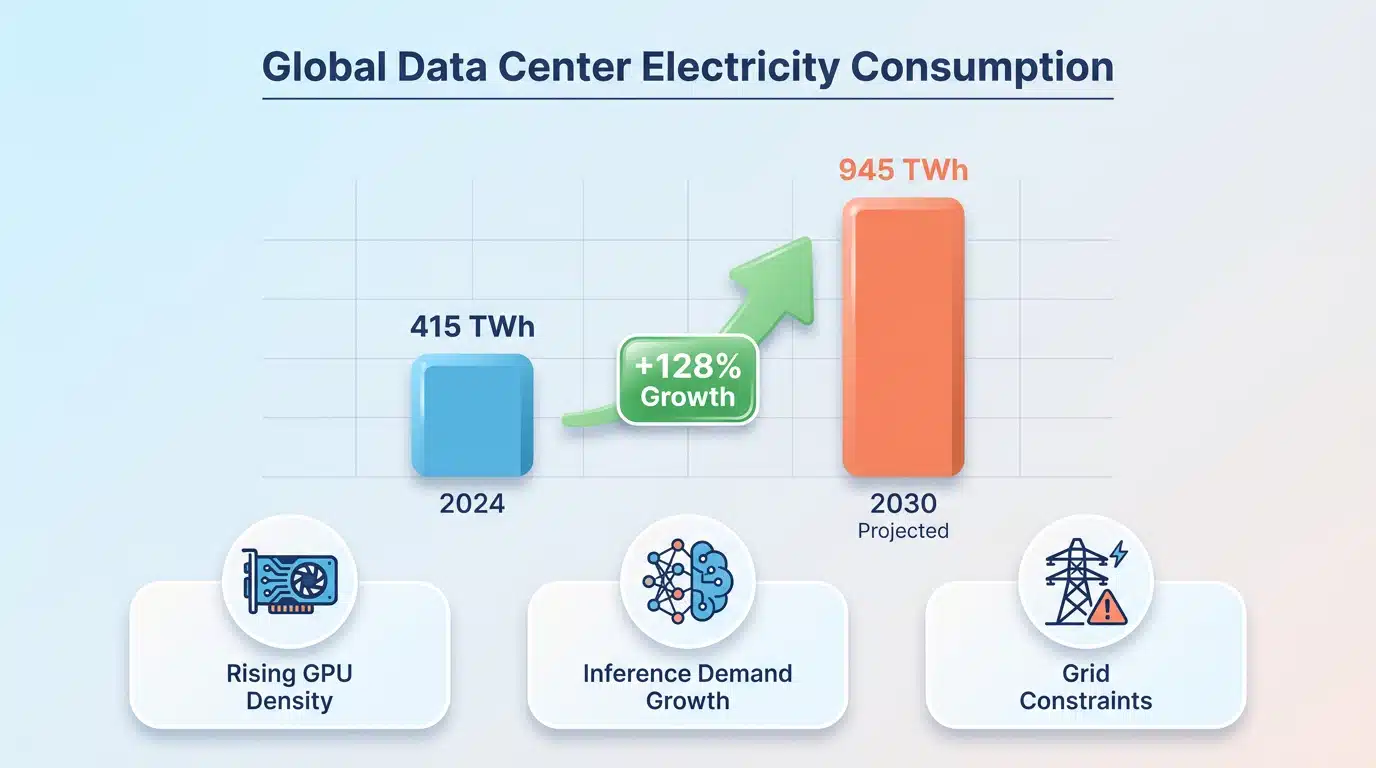
According to the International Energy Agency, global data center electricity consumption will more than double by 2030, reaching approximately 945 terawatt-hours annually. That figure is roughly equivalent to Japan’s entire annual electricity consumption today. Understanding the energy usage of AI models has become essential for anyone involved in planning, operating, or investing in digital infrastructure.
What Drives the Energy Usage of AI Models?
The power demands of artificial intelligence differ fundamentally from traditional computing. Where conventional data processing handles cyclical workloads with predictable peaks and valleys, AI operations require sustained, maximum-capacity performance that pushes electrical infrastructure to its limits.
GPU Architecture Creates Higher Power Density
Modern AI relies on graphics processing units designed for parallel processing at massive scale. These chips were originally developed for rendering complex graphics, but their architecture proves ideal for the matrix mathematics underlying neural networks. The tradeoff is significant power consumption.
According to Goldman Sachs research, data center power demand will increase 165% by 2030, driven largely by the shift from traditional CPU-based computing to GPU-intensive AI workloads. AI-focused facilities now require power densities that far exceed traditional data centers, with individual racks supporting AI workloads demanding substantially more electricity than conventional enterprise computing.
| Data Center Type | Typical Power Density | Primary Use Case |
| Traditional Enterprise | 10-15 kW per rack | General computing |
| Cloud/Hyperscale | 15-30 kW per rack | Cloud services |
| AI-Optimized | 50-150 kW per rack | Model training/inference |
This density shift represents more than an engineering challenge. It fundamentally changes site selection criteria, where power availability now matters more than real estate costs or network proximity. The energy usage of AI models has made grid interconnection capacity the primary constraint on new deployments.

Training Versus Inference: Where Does Energy Actually Go?
Discussions about AI power consumption often focus on training large language models, and those numbers are indeed striking. Training a single foundation model can consume hundreds of megawatt-hours over weeks or months of continuous operation. However, this framing misses the larger picture of LLM energy use.
Research published by IEEE Spectrum indicates that a typical generative AI query consumes approximately 2.9 watt-hours of electricity, while a standard web search uses roughly one-tenth of that amount. This difference, multiplied across billions of daily interactions, creates aggregate demand that represents a significant portion of overall AI data center consumption.
The energy usage of AI models during inference also exhibits characteristics that challenge traditional grid planning. Unlike batch processing jobs that can be scheduled during off-peak hours, real-time AI services must respond instantly to user requests, creating demand profiles that remain relatively flat throughout the day. This continuous operational requirement shapes how organizations must approach energy procurement and infrastructure development.
How Is AI Power Consumption Changing Data Center Requirements?
The shift toward AI workloads has created entirely new categories of infrastructure challenges. Facilities designed for traditional computing simply cannot accommodate the power density and reliability standards that AI operations demand. Understanding these requirements is essential for organizations planning next-generation AI data center infrastructure.
Power Density Exceeds Traditional Infrastructure
Modern AI data centers require substantially more power per square foot than traditional facilities. This density shift reflects the transition from CPU-based architectures to GPU clusters that perform the parallel computations AI requires.
The implications extend beyond simply delivering more electricity. Site development must account for utility capacity from the earliest planning stages. Transmission infrastructure may require significant upgrades before new facilities can interconnect. These realities have made early engagement with energy infrastructure partners essential for organizations pursuing AI deployments.
Continuous Operations Eliminate Load Flexibility
Traditional data centers experience meaningful variation in power demand throughout the day and week. This flexibility allows operators to coordinate with utilities around peak demand periods and take advantage of variable electricity pricing.
AI data center operations offer no such flexibility. Training sessions cannot pause without losing computational progress and extending already lengthy timelines. Inference workloads must respond to user demand in real-time. The result is baseload power requirements that remain essentially constant around the clock, making AI power consumption uniquely challenging from a grid integration perspective.
What Does LLM Energy Use Mean for Infrastructure Planning?
The energy demands created by large language models and other AI systems are forcing a fundamental reconsideration of how digital infrastructure gets built. Power availability has replaced traditional factors like labor costs or network proximity as the primary constraint on AI data center development.
Grid Constraints Create Deployment Bottlenecks
Electrical utilities in major data center markets are struggling to accommodate new demand. According to Pew Research analysis of Department of Energy data, US data centers consumed 183 terawatt-hours in 2024, representing more than 4% of national electricity consumption. That share is projected to grow substantially as AI adoption accelerates.
The challenge extends beyond raw capacity. Grid interconnection in high-demand markets now involves extended waiting periods as utilities work to upgrade transmission infrastructure. Organizations planning hyperscale deployments find themselves constrained by infrastructure that was never designed for concentrated AI loads.
Northern Virginia illustrates these pressures clearly. The region hosts the largest concentration of data centers globally, yet available power capacity has become extremely scarce. Similar constraints exist across other major markets. The energy usage of AI models is creating competition for limited grid resources that will only intensify as adoption accelerates.
Geographic Distribution Becomes Strategic Necessity
The concentration of AI data center demand in traditional markets is driving interest in geographic diversification. Organizations increasingly evaluate sites based on power availability, grid reliability, and interconnection timelines rather than proximity to existing infrastructure.
| Market Factor | Traditional Priority | AI-Era Priority |
| Real estate cost | High | Moderate |
| Network latency | High | Moderate to High |
| Power availability | Moderate | Critical |
| Grid interconnection speed | Low | Critical |
| Renewable energy access | Variable | High |
This shift creates opportunities for regions with available power capacity and streamlined interconnection processes. It also increases the strategic value of energy campus development that can deliver powered land faster than traditional utility-led approaches.
5 Key Factors Shaping AI Data Center Energy Demand
Understanding the forces driving AI power consumption helps organizations plan infrastructure investments that will remain viable as workloads evolve.
- Model complexity continues increasing — Each generation of foundation models requires more parameters and computational operations, driving proportional increases in power demand for both training and inference.
- Deployment scale is accelerating — AI capabilities are moving from experimental applications to production systems serving millions of users, multiplying aggregate energy requirements regardless of per-query efficiency gains.
- Hardware efficiency improvements lag demand growth — While newer chips deliver better performance per watt, the scale of AI adoption is growing faster than efficiency improvements can offset, expanding overall LLM energy use.
- Inference dominates ongoing consumption — Organizations must plan for sustained operational power demands rather than focusing primarily on training requirements.
- Grid constraints limit expansion options — Power availability has become the binding constraint on AI deployment, making energy infrastructure partnership essential for competitive positioning.
How Can Organizations Address AI Power Consumption Challenges?
Meeting the energy demands of AI workloads requires strategic approaches that go beyond traditional data center planning. The focus must shift toward securing reliable power infrastructure before facility development begins.
Renewable Integration Provides Multiple Benefits
Renewable energy partnerships offer AI data center operators advantages beyond sustainability credentials. Direct power purchase agreements provide cost predictability that protects against volatile utility rates. On-site generation through solar and energy storage reduces transmission dependencies. Strategic co-location with renewable generation assets can enable faster deployment than waiting for traditional grid upgrades.
Major technology companies have already committed substantial capital to renewable partnerships. These investments reflect recognition that sustainable power supply is fundamental to long-term AI competitiveness. For organizations evaluating their own AI infrastructure strategies, understanding energy usage of AI models should inform every aspect of site selection and development planning.
Energy Campus Development Accelerates Deployment
The traditional model of building data centers and then securing power is inverting for AI workloads. Forward-thinking organizations now prioritize “powered land” development that establishes energy infrastructure before construction begins.

This approach involves securing strategic land with favorable characteristics, establishing utility connections and renewable generation capacity, and creating infrastructure that can scale with demand. By front-loading energy development, organizations can compress deployment timelines and reduce the risk that power constraints will limit AI capabilities. The LLM energy use projections through 2030 make this infrastructure-first approach increasingly essential.
Frequently Asked Questions
How much electricity does a single AI query consume?
A typical generative AI query consumes approximately 2.9 watt-hours, according to Schneider Electric research published by IEEE Spectrum. This is roughly ten times the energy of a standard web search. However, consumption varies significantly based on model complexity, response length, and whether the query involves text, image, or video generation.
Why do AI models use more energy than traditional software?
AI models rely on neural network architectures that perform billions of mathematical operations for each response. These computations require specialized processors running at high power levels. Traditional software executes predetermined instructions sequentially on processors that consume far less electricity per operation. This fundamental architectural difference drives the higher energy usage of AI models compared to conventional computing.
Is training or inference responsible for more AI energy consumption?
Inference dominates ongoing AI energy consumption. While individual training runs consume massive amounts of electricity, inference operations run continuously as millions of users interact with deployed models daily, creating far larger aggregate demand over a model’s operational lifetime.
What percentage of global electricity do data centers currently consume?
According to the International Energy Agency, data centers consumed approximately 415 terawatt-hours in 2024, representing about 1.5% of global electricity consumption. In the United States, the share exceeds 4%. These figures are projected to grow substantially, with global AI data center consumption expected to more than double by 2030.
Power Your AI Future with the Right Infrastructure Partner
The energy usage of AI models represents one of the most significant infrastructure challenges of our digital era. Organizations that secure reliable, scalable power capacity position themselves to compete effectively as AI capabilities become essential to business operations. Those without adequate energy partnerships risk falling behind as power constraints limit their ability to deploy and scale AI workloads.
Hanwha Data Centers specializes in developing energy campus infrastructure that addresses these challenges directly, delivering powered land solutions designed for the unique demands of AI operations. To explore how purpose-built energy infrastructure can support your AI ambitions, connect with the Hanwha Data Centers team today.


